![[IELTS Prep] The 30-Day IELTS Academic Band 7.5+ Blueprint (October 2026 Edition)](https://eduteci.com/data/attachments/0/672-b98992b549b4f591a1f8b773dc4de92e.jpg)


- Registrado
- 20 Oct 2025
- Mensajes
- 305
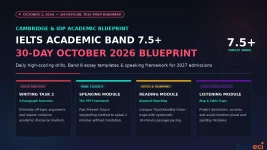
[IELTS Prep] The 30-Day IELTS Academic Band 7.5+ Blueprint (October 2026 Edition)
Today is October 1, 2026 — the official kickoff of the fourth and final quarter (Q4) of the academic testing year.
If you are planning to apply for international undergraduate or postgraduate programs for the 2027 intake (in the UK, Canada, the US, Australia, or Europe), October is your most crucial testing window. Most university application portals close between December 1 and January 15. Because receiving official Test Report Forms (TRFs) and requesting score dispatches takes time, taking your test between mid-October and late November is essential.
Scoring a Band 7.5 or higher does not require native-level fluency; it requires mastery of the assessment criteria (band descriptors) and strategic time management. Here is your actionable, 30-day preparation blueprint for October 2026.
1. Writing Task 2: The 4-Paragraph Band 8 Structure
The single biggest reason candidates remain stuck at Band 6.5 in Academic Writing is poor essay organization and underdeveloped arguments. To guarantee high marks in Task Achievement and Coherence & Cohesion, adopt a strict 4-paragraph architectural model:
Examiner Tip on Lexical Resource:** Avoid forced, archaic vocabulary. Instead of memorizing words like "plethora" or "myriad", focus on high-utility academic collocations: "substantive evidence", "mitigating factors", "disproportionate impact", "catalyze economic growth".
2. Speaking Part 2: The "PPF" Storytelling Framework
In Part 2 (the Long Turn), candidates have only 60 seconds to prepare and must speak uninterrupted for two full minutes on an unseen Cue Card topic. Many test-takers freeze at the 1-minute mark because they run out of things to say.
Use the Past - Present - Future (PPF) Framework to keep your speech structured and natural:
3. Reading Module: Defeating "True / False / Not Given"
Academic Reading consists of 3 passages and 40 questions in strictly 60 minutes (with no additional transfer time). Managing your pace is vital:
The Golden Rule for "NOT GIVEN" questions:
4. Listening Module: Eliminating Costly Distractor Errors
In the Computer-Delivered format, listening answers must be typed on screen in real time. Avoid these top three score traps:
5. The 4-Week October 2026 Study Calendar
Official Practice Platforms & References
Join the Discussion:**
Are you sitting for the IELTS or TOEFL this quarter? Which section do you currently find the most challenging (Writing Task 2 or Speaking Part 3)? Post your questions or sample paragraphs below for community feedback!
Today is October 1, 2026 — the official kickoff of the fourth and final quarter (Q4) of the academic testing year.
If you are planning to apply for international undergraduate or postgraduate programs for the 2027 intake (in the UK, Canada, the US, Australia, or Europe), October is your most crucial testing window. Most university application portals close between December 1 and January 15. Because receiving official Test Report Forms (TRFs) and requesting score dispatches takes time, taking your test between mid-October and late November is essential.
Scoring a Band 7.5 or higher does not require native-level fluency; it requires mastery of the assessment criteria (band descriptors) and strategic time management. Here is your actionable, 30-day preparation blueprint for October 2026.
1. Writing Task 2: The 4-Paragraph Band 8 Structure
The single biggest reason candidates remain stuck at Band 6.5 in Academic Writing is poor essay organization and underdeveloped arguments. To guarantee high marks in Task Achievement and Coherence & Cohesion, adopt a strict 4-paragraph architectural model:
Paragraph 1: Introduction (45-50 words)
- Sentence 1: Paraphrase the prompt using academic synonyms.
- Sentence 2: Clear Thesis Statement stating your precise position.
- Sentence 3: Outline statement foreshadowing your two main supporting points.
Paragraph 2: First Supporting Idea (90-100 words)
- Topic Sentence: State Idea A directly.
- Explanation: Elaborate on the mechanism or reason behind Idea A.
- Real-world Example: Provide a concrete, academic example (research study, institutional trend, or case).
- Impact Statement: Link back to your thesis.
Paragraph 3: Second Supporting Idea / Counterargument (90-100 words)
- Topic Sentence: State Idea B (or address the opposing view and refute it).
- Explanation: Provide in-depth justification.
- Specific Example: Illustrate with practical application.
- Concluding Link: Reaffirm your stance.
Paragraph 4: Conclusion (35-45 words)
- Restate your thesis in fresh phrasing.
- Synthesize your two main points into a forward-looking final thought.
Examiner Tip on Lexical Resource:** Avoid forced, archaic vocabulary. Instead of memorizing words like "plethora" or "myriad", focus on high-utility academic collocations: "substantive evidence", "mitigating factors", "disproportionate impact", "catalyze economic growth".
2. Speaking Part 2: The "PPF" Storytelling Framework
In Part 2 (the Long Turn), candidates have only 60 seconds to prepare and must speak uninterrupted for two full minutes on an unseen Cue Card topic. Many test-takers freeze at the 1-minute mark because they run out of things to say.
Use the Past - Present - Future (PPF) Framework to keep your speech structured and natural:
- The Past (40-45 seconds): Set the scene. Explain how you first discovered, experienced, or learned about the topic. Use varied past tenses: "I first came across this while I was studying..." or "Had it not been for my friend's recommendation, I probably never would have..."
- The Present (45-50 seconds): Describe the current reality. How does this object, person, or event impact your daily routine now? Use present perfect continuous: "Over the last few months, I've been increasingly dedicating time to..."
- The Future (25-30 seconds): Speculate and hypothesize. How do you envision this developing in the coming years? Incorporate conditionals: "Looking ahead, if I have the opportunity next year, I would certainly intend to..."
3. Reading Module: Defeating "True / False / Not Given"
Academic Reading consists of 3 passages and 40 questions in strictly 60 minutes (with no additional transfer time). Managing your pace is vital:
- Passage 1: Aim for 16 minutes maximum.
- Passage 2: 18 to 20 minutes.
- Passage 3: 22 to 24 minutes (highest linguistic complexity).
The Golden Rule for "NOT GIVEN" questions:
TRUE: The passage clearly confirms the exact meaning of the statement.
FALSE: The passage states the direct opposite or contradicts the premise.
NOT GIVEN: You can neither verify nor refute the claim using only the text provided. Do not use outside common sense or general knowledge — if the text does not explicitly confirm or contradict the statement, it is Not Given.
4. Listening Module: Eliminating Costly Distractor Errors
In the Computer-Delivered format, listening answers must be typed on screen in real time. Avoid these top three score traps:
- The Self-Correction Distractor: Speakers frequently give one answer and immediately correct themselves: "We will meet on Thursday... oh wait, the room is booked, let's make it Friday." Always listen through the pause.
- Singular vs. Plural endings (-s): Missing a final "s" in a fill-in-the-blank question marks the entire item incorrect. Double-check grammar agreement in the surrounding sentence.
- Word Count Limits: If the instruction states "NO MORE THAN TWO WORDS AND/OR A NUMBER", writing three words results in an automatic zero, even if the content is correct.
5. The 4-Week October 2026 Study Calendar
- Week 1 (Oct 1 - Oct 7): Full diagnostic mock test under strict timed conditions. Identify weak skills and build custom vocabulary banks for Education, Environment, and Technology.
- Week 2 (Oct 8 - Oct 15): Intensive Writing Task 1 (Trends, Maps, Processes) and Task 2 paragraph drafting. Practice writing full essays by hand or on a standard QWERTY keyboard in under 40 minutes.
- Week 3 (Oct 16 - Oct 23): Daily Speaking simulations (record yourself on your phone and transcribe your answers to eliminate filler sounds like "um", "like", or pauses). Practice True/False/Not Given drills.
- Week 4 (Oct 24 - Oct 31): Three full authentic Cambridge practice tests at the exact time of day you will sit your real test. Review mistakes thoroughly and finalize test registration.
Official Practice Platforms & References
- Official test dates and registration: IELTS Official Organization (British Council / IDP)
- Free practice tests and assessment rubrics: Cambridge English - IELTS Resources
- Grammar and listening exercises: British Council LearnEnglish
Join the Discussion:**
Are you sitting for the IELTS or TOEFL this quarter? Which section do you currently find the most challenging (Writing Task 2 or Speaking Part 3)? Post your questions or sample paragraphs below for community feedback!


Archivos adjuntos