

- Registrado
- 20 Oct 2025
- Mensajes
- 285
Comprehensive guide to the DAAD EPOS Scholarship in Germany. Learn how to secure €934 monthly allowance, full health insurance, travel grants, and tuition-free Master's degrees taught in English.
Germany remains one of the world's most attractive destinations for higher education, renowned for its academic excellence, cutting-edge research facilities, and its landmark policy offering tuition-free education at public universities for domestic and international students alike.
For professionals and graduates from emerging and developing nations, the DAAD (Deutscher Akademischer Austauschdienst / German Academic Exchange Service) offers one of the most generous funding streams in existence: the Development-Related Postgraduate Courses (EPOS) scholarship. This program funds selected master's and doctoral degrees across engineering, environmental sciences, public policy, economics, and healthcare.
1. What Financial Benefits Does DAAD EPOS Provide?
Because public higher education in Germany is heavily state-subsidized, scholars do not pay tuition. The DAAD scholarship covers your entire cost of living and logistical expenses:
2. Core Eligibility Requirements
To be considered for an EPOS scholarship, candidates must fulfill strict academic and professional criteria:
3. Eligible Fields of Study Under EPOS
The EPOS catalogue includes pre-selected master's programs specifically structured for international professionals, including:
4. Step-by-Step Application Timeline
5. Official Resources & Application Links
Ensure all application requirements are verified through official DAAD portals:
Study in Germany for Free: Complete Guide to the DAAD EPOS Fully Funded Scholarship
Pursue an English-taught Master's degree at top German universities with zero tuition fees and a €934 monthly living allowance.
Pursue an English-taught Master's degree at top German universities with zero tuition fees and a €934 monthly living allowance.
Germany remains one of the world's most attractive destinations for higher education, renowned for its academic excellence, cutting-edge research facilities, and its landmark policy offering tuition-free education at public universities for domestic and international students alike.
For professionals and graduates from emerging and developing nations, the DAAD (Deutscher Akademischer Austauschdienst / German Academic Exchange Service) offers one of the most generous funding streams in existence: the Development-Related Postgraduate Courses (EPOS) scholarship. This program funds selected master's and doctoral degrees across engineering, environmental sciences, public policy, economics, and healthcare.
1. What Financial Benefits Does DAAD EPOS Provide?
Because public higher education in Germany is heavily state-subsidized, scholars do not pay tuition. The DAAD scholarship covers your entire cost of living and logistical expenses:
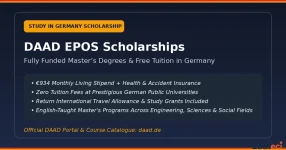
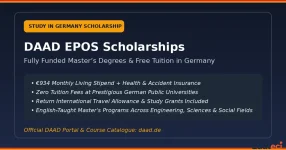
- Monthly Living Stipend: €934 per month for master's degree students (and €1,300 per month for doctoral candidates) to cover accommodation, food, and personal living expenses.
- Comprehensive Health & Liability Insurance: Mandatory health, accident, and personal liability insurance coverage fully paid by the DAAD.
- Travel Allowance: Return economy class flight expenses between your home country and Germany (unless funded by your home government or another sponsor).
- Annual Study & Research Subsidy: A one-off annual grant (approx. €460) to assist with books, study equipment, and research materials.
- Preparatory German Language Training: Even if your master's program is taught 100% in English, DAAD funds an intensive German language course (typically 2 to 6 months) prior to academic studies to help you integrate smoothly into German society.
- Rent Subsidies and Family Supplements: Under certain qualifying conditions, monthly rent allowances or support for accompanying spouses/children may be granted.
2. Core Eligibility Requirements
To be considered for an EPOS scholarship, candidates must fulfill strict academic and professional criteria:
- Academic Degree: Hold a recognized undergraduate Bachelor's degree (typically 4 years) in a discipline directly relevant to the targeted postgraduate course.
- Degree Recency: As a general rule, your most recent academic degree should not have been obtained more than six years prior to the application date.
- Verifiable Professional Work Experience: Applicants must possess at least two years of professional work experience gained after graduating from their bachelor's degree in a relevant field (e.g., in ministries, public authorities, chambers of commerce, NGOs, or business enterprises).
- Language Competence:
- For English-taught courses: Valid certificate such as IELTS (Academic) or TOEFL iBT (institutional institutional tests like TOEFL ITP are rarely accepted).
- For German-taught courses: Valid DSH-2 or TestDaF-4 certificate.
- Clear Developmental Focus: Candidates must articulate a compelling development-oriented motivation demonstrating how their studies will contribute to solving structural challenges in their home country.
Crucial Application Distinction: Unlike general university admissions where you apply through Uni-Assist, most DAAD EPOS applications must be submitted directly to the individual German university offering the selected master's program, following their university-specific deadlines.
3. Eligible Fields of Study Under EPOS
The EPOS catalogue includes pre-selected master's programs specifically structured for international professionals, including:
- Economic Sciences & Business Administration: International Management, Development Economics, and Small Enterprise Promotion.
- Development Cooperation: Sustainable Development Management and Public Policy.
- Engineering & Environmental Sciences: Renewable Energy Systems, Water Resources Management, Sustainable Mining, and Photovoltaics.
- Urban & Regional Planning: Infrastructure Planning and Urban Governance.
- Public Health & Medicine: Global Health and International Health Sciences.
4. Step-by-Step Application Timeline
- May – August: Review the official DAAD EPOS brochure, select your top preferred programs (you can choose up to two courses, prioritized in order of preference).
- August – October / December: Submit complete application packages directly to the respective universities (deadlines vary by institution; some close as early as August 31, while others close in October or December for courses starting the following autumn).
- January – March: University selection committees evaluate candidates and submit shortlisted nominees to the DAAD.
- May – June: DAAD issues official award letters and visa guidance.
- October: Winter semester commences in Germany (or earlier in summer for preparatory German language courses).
5. Official Resources & Application Links
Ensure all application requirements are verified through official DAAD portals:
- EPOS Scholarship Database Profile: DAAD Development-Related Postgraduate Courses (EPOS) Overview
- DAAD Official Programme Information: DAAD EPOS Institutional Program Hub
- General DAAD Scholarship Search Engine: DAAD Scholarships Overview & Database
Are you preparing your application for studies in Germany or have questions regarding work experience requirements? Join the discussion below!
Archivos adjuntos